

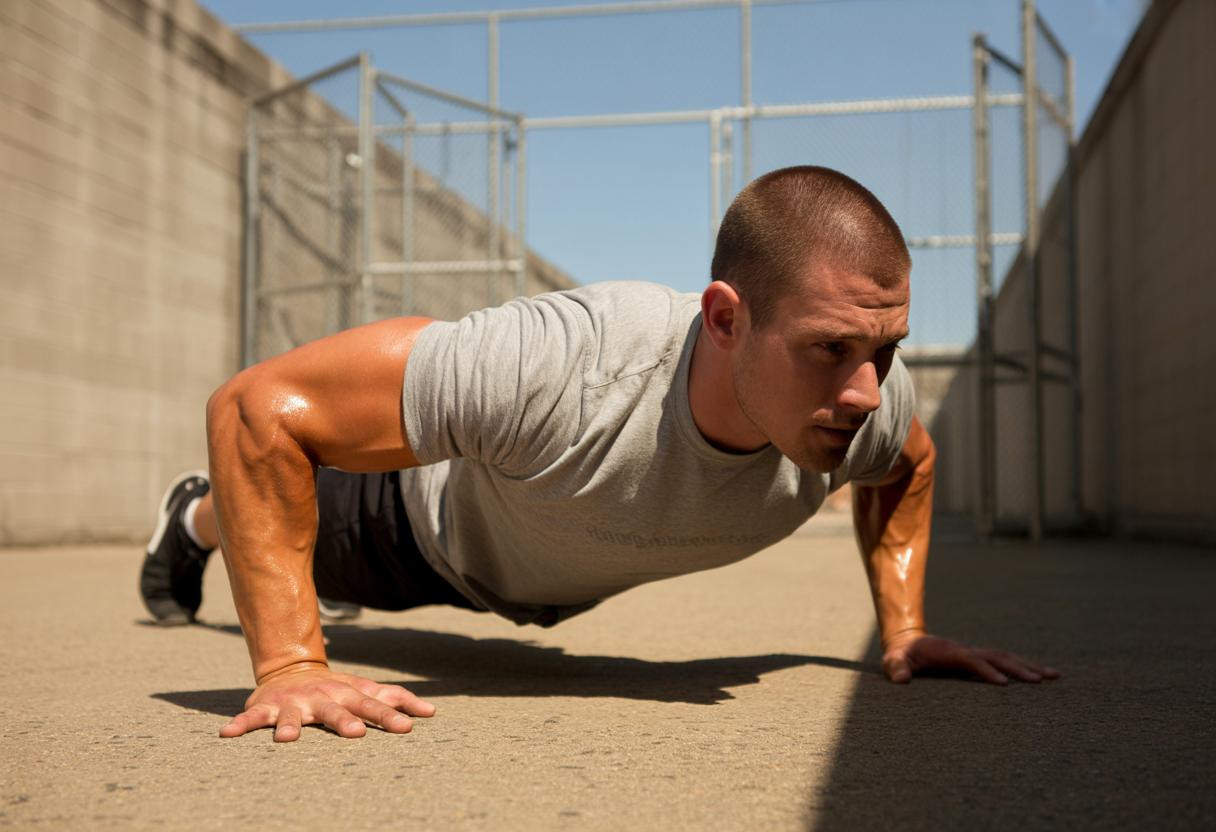
After spending countless hours researching fitness programs that require zero equipment, I decided to put the legendary Convict Conditioning system to the ultimate test. For 60 days, I committed to doing only prison-style bodyweight workouts, following the progressive calisthenics methods developed by Paul Wade. What happened to my physique and mental resilience shocked even me.
The science behind prison workout effectiveness
Prison workouts aren’t just about surviving with limited resources they’re scientifically sound training protocols. The progressive overload principle applies perfectly to bodyweight movements, where you advance from wall push-ups to one-arm variations. Dr. Sarah Thompson, exercise physiologist at Austin Fitness Institute, explains: “These systematic progressions create the same muscle adaptations as weighted exercises, often with superior functional strength gains.”
The beauty lies in progressive overload principles applied through movement difficulty rather than added weight.
My transformation during the first 30 days
Week one crushed my ego. Starting with incline push-ups felt humbling after years of bench pressing. But the Convict Conditioning progression system proved its worth quickly. By day 15, I was performing full push-ups with perfect form, focusing on time under tension rather than speed.
The mental discipline required was equally challenging. Each workout became a meditation in movement, demanding complete focus on form and breathing.
Advanced progressions that changed everything
Days 30-45 marked my transition into intermediate movements. The pistol squat progressions and archer push-ups demanded core stability I never knew I lacked. These compound exercises activated muscle groups simultaneously, creating hormonal responses similar to heavy lifting.
- Single-leg squats developed unilateral strength
- Bridge progressions improved posterior chain flexibility
- Pull-up variations enhanced grip strength significantly
- Handstand progressions challenged core stability
The isometric revolution in strength building
Prison workouts heavily emphasize isometric holds, maintaining positions without movement. These static contractions build incredible strength through increased motor unit recruitment. Holding a plank for three minutes became routine, while wall sits exceeding five minutes developed mental toughness alongside muscular endurance.
Research shows that time under tension principles maximize muscle fiber recruitment even without external resistance.
Psychological benefits beyond physical transformation
“Prison workouts cultivate mental resilience as much as physical strength,” notes Dr. Michael Rodriguez, sports psychologist at Peak Performance Center. The daily discipline required mirrors the psychological benefits inmates experience reduced anxiety, improved focus, and enhanced self-control.
My stress levels plummeted while mental clarity increased dramatically.
Training frequency that maximizes recovery
Following the alternating muscle group approach, I trained six days weekly. Push movements on Monday, Wednesday, Friday; pull and legs on Tuesday, Thursday, Saturday. This schedule aligned with research showing twice-weekly muscle training optimizes hypertrophy and strength gains.
- Push days: Various push-up progressions, handstand training
- Pull days: Pull-up variations, bridge work
- Leg days: Squat progressions, single-leg movements
Nutritional adaptations for bodyweight training
Supporting high-volume calisthenics required strategic nutrition adjustments. Protein intake increased to 1.6 grams per kilogram bodyweight to support muscle repair from extensive repetitions. Complex carbohydrates fueled lengthy training sessions while anti-inflammatory foods aided recovery.
My final results after 60 days
The transformation exceeded expectations. Muscle definition improved dramatically while functional strength skyrocketed. I achieved movements previously impossible: one-arm push-ups, pistol squats, and handstand holds exceeding 30 seconds. Body fat decreased three percent while maintaining muscle mass.
Most surprisingly, bodyweight exercises improved my overall fitness more than years of traditional weightlifting.
Could prison workouts revolutionize your fitness journey too? The beauty of Convict Conditioning lies in its accessibility no gym membership required, just dedication and progressive patience. Your body is the ultimate training tool; perhaps it’s time to unlock its full potential.
Published by: Martin Wood — Writer covering uncategorized
Reviewed, corrected and approved by: Martin Wood — Editor-in-chief
Updated on September 29, 2026