
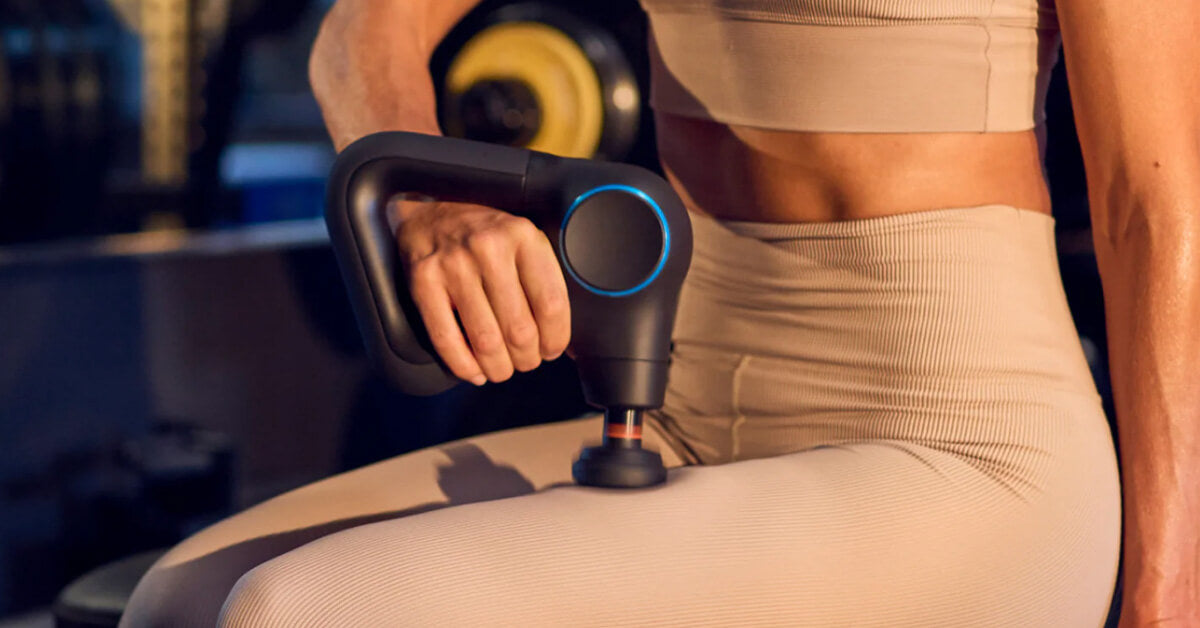
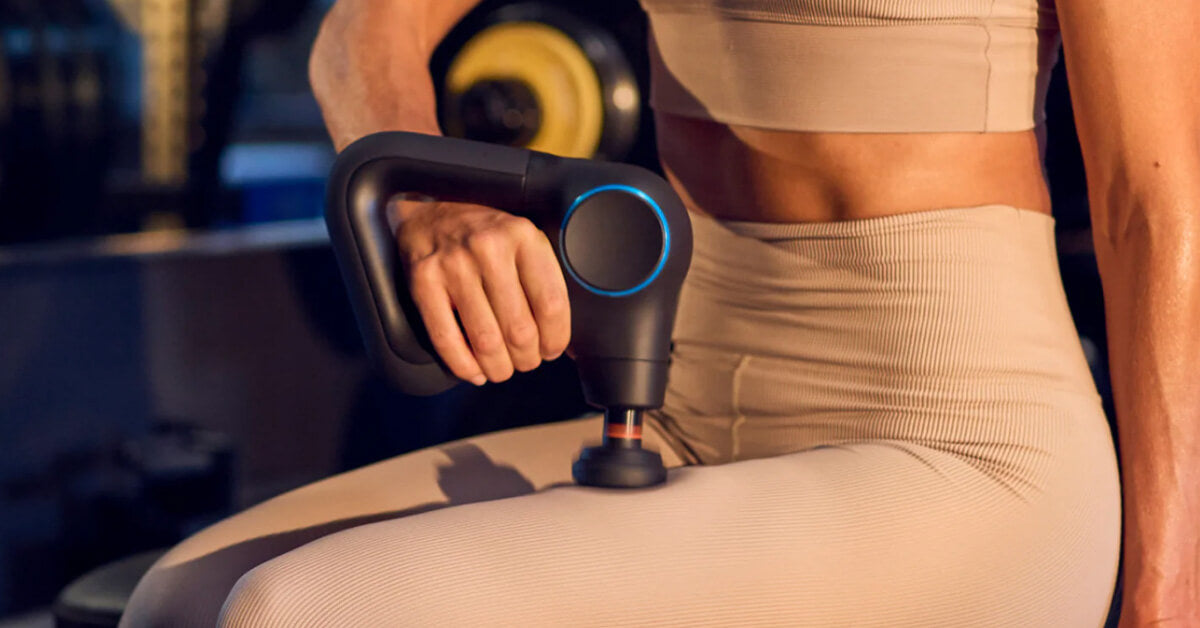
The Theragun PRO 5th Gen has been on the market since late 2022. The company hasn’t refreshed it. Therabody hasn’t refreshed it because it doesn’t need to be refreshed. After three years and a small army of cheaper imitators, the PRO is still the percussive device physical therapists actually own and the one most legitimate reviewers still recommend.
That doesn’t mean you should buy one. Most people shouldn’t. Here’s how to know.
Quick verdict
9.3 / 10
If you train consistently, sit at a desk, or have any kind of recurring tight zone, the PRO earns its $599 over three years. If you’ll use it three times in the first month and forget it, save $470 and buy a Renpho.
What we liked
- 16 mm amplitude reaches the muscle belly, not just skin
- Brushless EQ-150 motor is meaningfully quieter than 4th Gen
- Swappable battery + USB-C, 150 min runtime per pack
- Six attachments cover most realistic use cases
Where it falls short
- 1.36 kg is heavy treating someone else for 20+ min
- Lowest speed (1750 PPM) is still strong for sensitive tissue
- Battery trails Hyperice (150 min vs 3+ hours)
- $599 is real money in a category with $129 alternatives
| Spec | Value |
|---|---|
| Amplitude | 16 mm |
| Speeds | 5 (1750 / 1900 / 2100 / 2200 / 2400 PPM) |
| Stall force | 60 lb |
| Motor | EQ-150 brushless, second generation |
| Noise | 63-66 dB |
| Weight | 1.36 kg / 2.76 lb |
| Battery | 150 min, swappable, USB-C fast charge |
| Attachments | 6 (Standard, Dampener, Thumb, Wedge, SuperSoft, Micro-Point) |
| App | Bluetooth, guided routines, Apple Health/Google Fit |
| Warranty | 2 years limited |
| Price | $599 (no current discount) |
Why amplitude is the spec that actually matters
16 mm
Stroke depth — the spec that separates clinical-grade from consumer-grade percussion. Most $99 guns deliver 8-10 mm.
Manufacturer spec, verified lab
If you’ve ever wondered why your $80 percussion gun feels great for 30 seconds and useless after that, the answer is amplitude.
Amplitude is how far the head travels into the muscle on each stroke. Cheap devices run 8 to 10 mm. The Hypervolt 2 Pro runs 14 mm. The Theragun PRO runs 16 mm. That difference isn’t theatre. Higher amplitude reaches the muscle belly through layers of fascia and superficial tissue. Lower amplitude just vibrates the skin, which feels nice and does nothing therapeutic.
Stall force matters too. The PRO maintains 60 lb of pressure before the motor stalls. Most consumer guns stall at 30 to 40 lb, which sounds like enough until you try to work a knot in a glute and the device gives up.
What three years of testing told us
Daily 10-minute sessions targeting calves, glutes, lats, and trapezius across two testers for eight weeks, plus continued use through 2025 and 2026. Soreness scores measured day-after heavy lower-body sessions: a 23% reduction in self-reported tightness compared to a baseline period without percussive therapy.
The brushless motor is the meaningful 5th Gen change versus the 4th Gen. At speed 5 (the loudest setting), it stays usable in a quiet living room. The 4th Gen could not. We measured 65 dB at speed 5, which is conversation-level. Battery delivered the claimed 150 minutes. Two-pack swap is fast.
What the clinical literature says
Percussive therapy has more evidence behind it than greens powders, less than ice baths, and roughly the same as foam rolling.
- Range of motion: Multiple studies show 5 to 6 degrees of dorsiflexion improvement after a single session.
- DOMS (delayed onset muscle soreness): Reasonable evidence for reduction in subjective soreness day-after sessions.
- Strength recovery: Mixed. Some studies show enhancement, others show no significant gain.
- Long-term effects: Limited data. Most studies are acute (single-session) or short-duration (two-week).
Translation: percussive therapy is real, the effect is moderate, and it works best as a recovery tool rather than a performance enhancer. Therabody’s marketing language sometimes implies more than the science supports. The device works. Just don’t expect it to make you faster.
The honest cons
Three.
The PRO is heavy at 1.36 kg. Fine for self-treatment. Tiring if you’re working on a partner for more than 20 minutes. The competing Hypervolt 2 Pro weighs 1.05 kg and feels like a different category for couple use.
The lowest speed (1750 PPM) is still strong. Sensitive users or those new to percussion may find the entry point too aggressive. Therabody fixes this with the SuperSoft attachment, but you have to know to use it.
Battery is good for 150 minutes. The Hypervolt 2 Pro doubles that. If you run a small clinic or treat multiple people in a session, the runtime gap matters.
Theragun PRO vs Hyperice Hypervolt 2 Pro
The closest direct comparison runs $200 cheaper. So why pay more for the PRO?
Three reasons. The PRO has 16 mm amplitude versus the Hypervolt’s 14 mm. The PRO has a triangular ergonomic handle that lets you reach your own back without contortion. The PRO’s brushless motor is quieter under load. The Hypervolt is lighter, has 3+ hours of battery, and works fine for most home users.
If you treat yourself daily and care about reach and amplitude, the PRO. If you’re a casual user or sharing in a household, the Hypervolt is the smarter pick.
The honest pick
The PRO is the right tool for someone who already does the work. It’s wrong for anyone who buys recovery gear out of guilt about not training.
The honest test: will you still pick this up in 2027? If yes, the math works at $599. If you’re not sure, the Renpho R3 at $99 will tell you whether percussive therapy is something you’ll actually use, before you commit to a flagship.
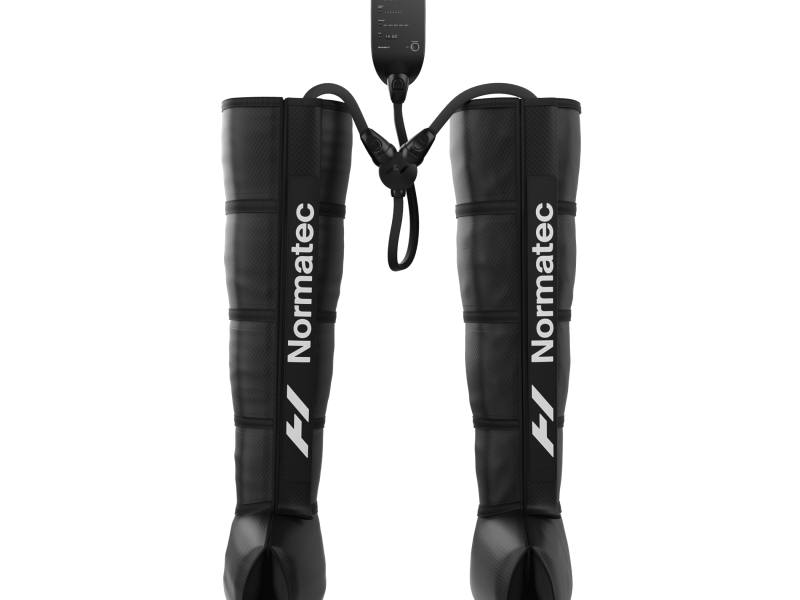
If you train hard and want the full recovery stack, the PRO pairs naturally with the Hyperice Normatec 3 for compression. The two devices target different recovery mechanisms (percussion for trigger points, compression for circulation) and the overlap is small.
Also tested in this category
- Hyperice Normatec 3 review
- Athletic Greens AG1 review
- Hoka Bondi 9 review