
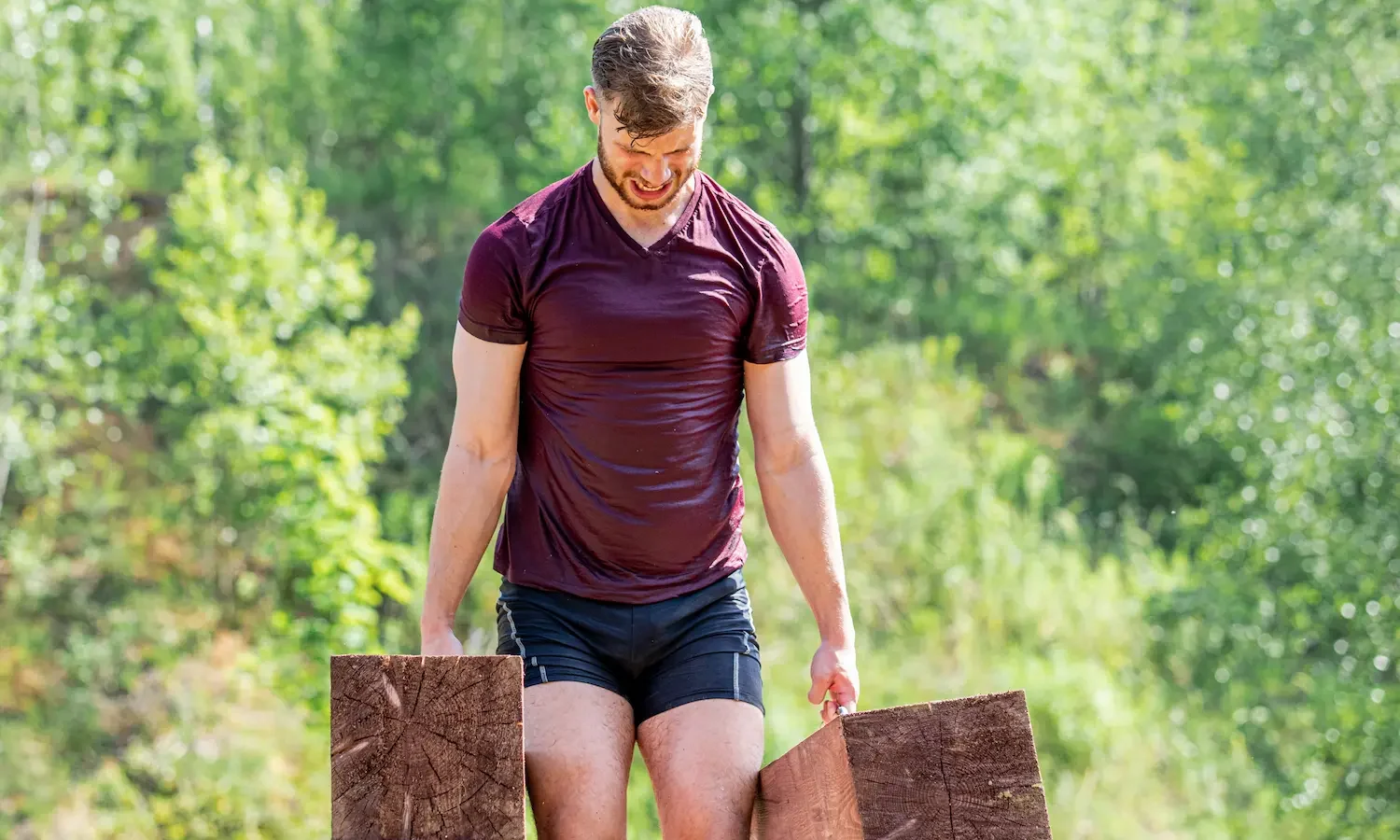
The farmer walk is the simplest and most universally useful loaded carry. You pick up two heavy weights (dumbbells, kettlebells, or farmer’s handles), and walk. That’s it. But under heavy load, walking transforms into one of the hardest full-body workouts you can do — building grip, traps, core, and total-body work capacity in a single exercise.
Strongman training has used farmer walks for over a century. Athletic programs use them as accessory work. Everyone should be doing them.
What is the farmer walk?
The farmer walk is a loaded carry exercise. You grip a heavy weight in each hand (dumbbells, kettlebells, or specialised farmer’s handles), stand up tall, and walk a prescribed distance or for a prescribed time. The weights hang at the sides; the body stays upright and stable.
What looks like just “walking with weights” is, in reality, a brutal full-body exercise. The grip works to hold the load. The traps, lats, and entire upper back stabilise to keep the shoulders from dropping. The core fires hard to resist the lateral load. The legs do the work of walking. Everything works together — and quickly.
Muscles worked
| Muscle group | Role | Contribution |
|---|---|---|
| Forearm grip muscles | Primary mover, grip support | ~25 % |
| Traps, upper back | Scapular stability, anti-shrug | ~20 % |
| Core, obliques | Anti-lateral-flexion, anti-rotation | ~20 % |
| Quads, glutes, hamstrings | Walking propulsion | ~25 % |
| Lats, posterior chain | Stabilisation, body line | ~10 % |
The farmer walk hits more muscles per minute than almost any other exercise. The grip and trap demand alone justifies it in any program. The carryover to deadlift performance is immediate — most lifters who add farmer walks 2x/week see their deadlift 1RM jump within weeks.
How to farmer walk: 5 steps
-
Set up the weights
Place two heavy dumbbells, kettlebells, or farmer's handles at your sides. Stand between them, feet shoulder-width. **Brace the core**, hinge at the hips, grip both weights firmly.
-
Stand up tall
**Deadlift the weights to standing.** Stand fully upright — shoulders pulled back and down (anti-shrug), chest up. The weights hang at the sides with arms straight. **Lats engaged, scapulae depressed.**
-
Walk with control
**Walk forward with normal stride length** — don't shuffle. **Body stays vertical** — no leaning to either side. Brace the core hard the entire time to resist lateral pull. Breath steady.
-
Maintain posture throughout
**Keep the shoulders pulled back and down** the entire carry — they want to shrug up or roll forward. **Resist that.** Chest up, head neutral, weights swing freely at the sides.
-
Set down with control
When you reach the target distance, **stop completely, hinge at the hips**, and lower the weights to the floor with control. Reset, rest, repeat. Never drop weights from standing.
Common mistakes to avoid
Variations
- Trap-bar farmer walk. Use a trap bar (hex bar) loaded heavy. Allows much higher loads than two dumbbells.
- Single-arm farmer walk (suitcase carry). One arm at a time. Massive anti-lateral-flexion core work — see also our suitcase carry guide.
- Overhead farmer walk. Weights held overhead. Brutal on shoulder stability and core.
- Front-rack carry. Weights held in front rack position (kettlebells or dumbbells at shoulders). Core and front-rack endurance.
- Yoke walk. Strongman implement with weight loaded on a yoke across the shoulders. Different mechanics, similar full-body demand.
- Deadlift. Static pickup version.
Sample workouts
Strength block
4 sets × 30 m heavy farmer walks. Load: 30-50 % of your deadlift 1RM total (so ~15-25 % per hand for a deadlift of 200 kg). Rest 2-3 minutes.
Grip endurance
5 sets × 60 seconds moderate carry. Don’t set the weights down — grip must hold for the full duration.
Conditioning finisher
3 rounds: 40 m farmer walk + 15 burpees + 30-second plank. Race the clock.
Frequently asked questions
How heavy should I farmer walk?
Start at 25-30 % of bodyweight per hand. Most committed lifters work up to 50-75 % of bodyweight per hand for 30-40 m carries. Strongmen carry 100 %+ of bodyweight per hand. Start light, build over months.
Why are farmer walks great for grip?
Heavy load + long duration. Most grip work (deadlift sets, pull-ups) lasts seconds. Farmer walks load the grip continuously for 20-60+ seconds at heavy intensity. That extended time under tension grows forearm size and strength rapidly.
Farmer walk or trap-bar carry?
Trap-bar carry allows much heavier loads than two dumbbells (you can load 200+ kg on a trap bar). For pure load, trap bar wins. For accessibility (most gyms have dumbbells; few have trap bars set up for walking), the farmer walk wins.
How often should I farmer walk?
2-3 times per week is enough. Heavy farmer walks fatigue the grip and traps — too much frequency reduces deadlift and pulling work quality. Use them as an end-of-workout finisher on pull days.
My grip fails before everything else — what should I do?
That’s normal — grip is usually the weakest link. Use chalk to maximise grip surface. Train grip directly with dead hangs and heavy holds. Use straps only when grip failure prevents the leg/trap work from getting done (rare).
Related exercises
- Suitcase Carry: unilateral farmer walk
- Deadlift: static pickup
- Trap Bar Deadlift: deadlift variation
- Sled Push: leg-power conditioning
- Dumbbell Row: back compound
Published by: Jay — Writer covering back exercises
Reviewed, corrected and approved by: Martin Wood — Editor-in-chief
Updated on September 29, 2026