
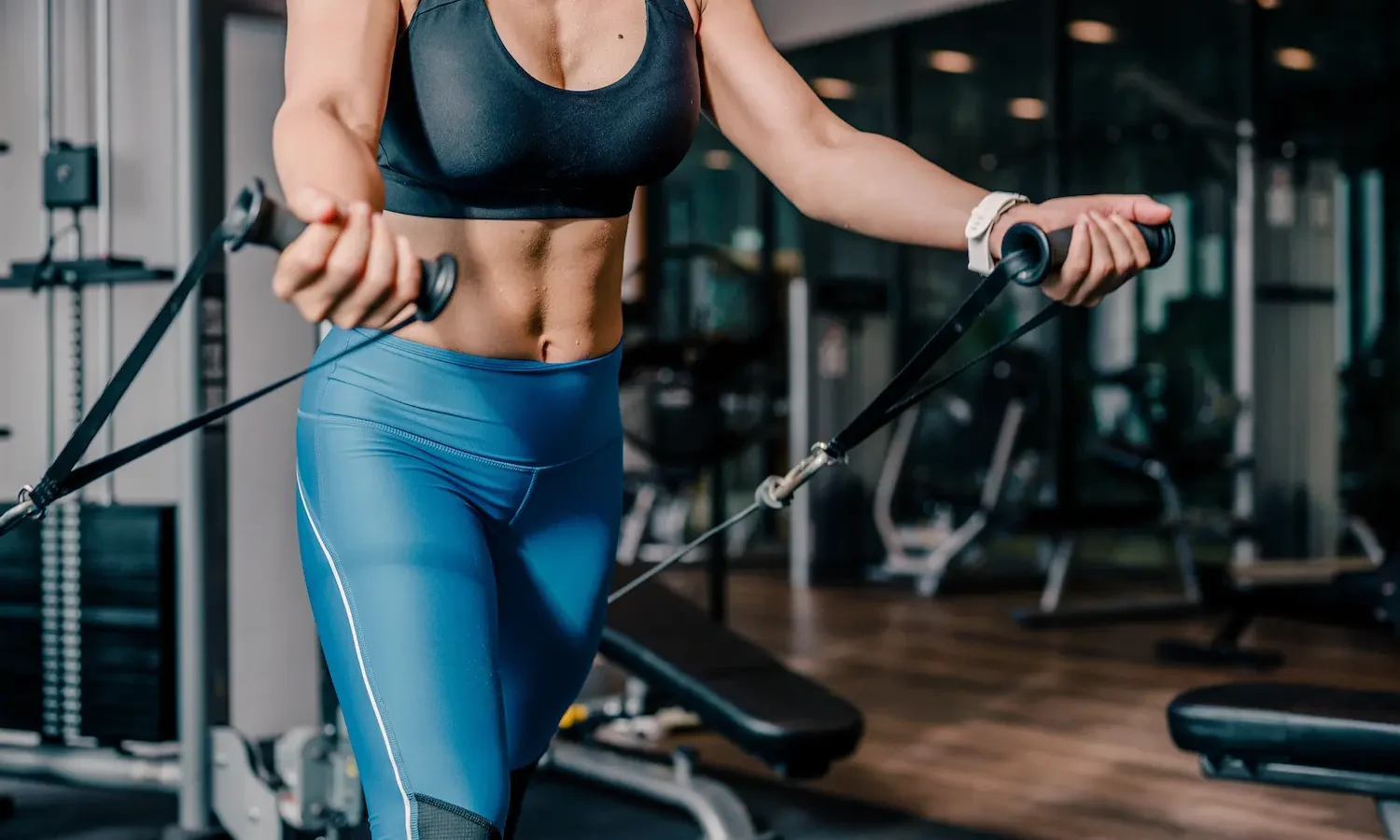
The cable wood chop is the standout rotational core exercise. Mimicking the motion of swinging an axe down across the body, it builds the obliques and serratus anterior in a functional pattern that carries over to sports, athletic rotation, and golf/tennis swings. Few core exercises train rotation under load this cleanly.
This guide covers the high-to-low cable wood chop, the standard variation. The reverse (low-to-high) is also valuable for upward rotation strength.
What is the cable wood chop?
The cable wood chop is a rotational cable core exercise performed standing beside the cable column. With the cable set at a high pulley, you grip a single handle with both hands and pull it diagonally down and across the body — finishing low on the opposite hip — by rotating through the trunk. The arms are essentially fixed; the rotation comes from the core.
The exercise loads the obliques and serratus in a way that mimics real athletic rotation. Every twisting sport (golf, tennis, baseball, hockey, MMA) demands strong rotational power. The cable wood chop trains it directly.
Muscles worked
| Muscle group | Role | Contribution |
|---|---|---|
| Obliques (internal + external) | Primary mover, trunk rotation | ~50 % |
| Rectus abdominis | Stabilisation, spinal flexion assist | ~15 % |
| Serratus anterior | Scapular protraction, trunk integration | ~15 % |
| Glutes, hip rotators | Hip stabilisation, anti-rotation | ~10 % |
| Lats, shoulders | Arm position support | ~10 % |
Unlike crunches that train spinal flexion only, the cable wood chop trains the obliques in their primary function — trunk rotation. It’s the single most useful ab exercise for athletes.
How to cable wood chop: 5 steps
-
Set up the cable
Attach a single handle to the **high pulley**. Stand sideways to the cable column, about 60 cm away. Grip the handle with both hands, arms extended toward the cable. Feet shoulder-width.
-
Set the start position
Hands together near the upper shoulder closest to the cable. **Brace the core hard.** Arms slightly bent, locked at this angle throughout. Hips and feet stable.
-
Chop down across the body
**Rotate the trunk** to pull the cable diagonally down and across the body, finishing at the hip on the opposite side from where you started. Pivot the back foot slightly (20-30°) as rotation occurs. **Power comes from the obliques, not the arms.**
-
Pause at the bottom
Brief pause at the bottom position — hands at the far hip, body fully rotated. Squeeze the obliques.
-
Return with control
Reverse the rotation in 2 seconds back to the start position. Maintain core brace throughout. Reset, repeat. Switch sides after the set.
Common mistakes to avoid
Variations
- Low-to-high cable chop (reverse chop). Cable from low pulley, pull up and across the body. Trains rotation in the opposite direction.
- Half-kneeling cable wood chop. One knee on the floor. Removes hip cheating, more strict.
- Standing cable wood chop. The standard version (this guide).
- Horizontal cable chop (Pallof press). Cable from chest height, push out and back — anti-rotation hold version.
- Medicine ball rotational throw. Free-weight power equivalent.
- Russian twist. Bodyweight rotational alternative.
Sample workout: 4-week rotational core block
Cable wood chops 2-3 times per week. Sets per side. Match strength on both sides — start with the weaker side first.
| Week | Sets × reps/side | Tempo |
|---|---|---|
| 1 | 3 × 12 | 1 sec chop + 2 sec return |
| 2 | 3 × 15 | 1 sec chop + 2 sec return |
| 3 | 4 × 10 explosive | Fast chop + 2 sec return |
| 4 (deload) | 3 × 12 | Smooth |
Frequently asked questions
Cable wood chop or Russian twist?
Different goals. The cable wood chop is loaded and athletic (rotation against resistance). The Russian twist is bodyweight and endurance-focused. For athletes who twist (golf, tennis, MMA), the cable chop is far more useful. For general ab training, both work.
Should the hips rotate too?</h3
Slightly, yes — about 20-30°. Full hip rotation = the move becomes a torque exercise, not a core exercise. Slight pivot of the back foot is natural and useful for athletic carryover.
How heavy should I cable chop?</h3
Moderate. Too heavy and the lats/arms take over (you start rowing instead of rotating). Most lifters work between 20-40 kg for 12 reps. The chop should feel like a controlled rotational pull, not a brute heave.
Why does my back hurt after wood chops?</h3
The lower back is rotating instead of the thoracic spine (mid-back). Brace the core hard, focus rotation on the rib cage relative to the pelvis. If pain persists, switch to half-kneeling or Pallof press first.
How long does it take to build rotational power?</h3
2-3 months of consistent training (2x/week minimum). Athletes see meaningful sport-specific gains in golf/tennis/baseball swing speed within 6-8 weeks of dedicated rotational core training.
Related exercises
- Russian Twist: bodyweight rotational
- Side Plank: anti-rotation oblique work
- Pallof Press: anti-rotation cable
- Plank: foundational anti-extension
- Cable Crunch: loaded spinal flexion