
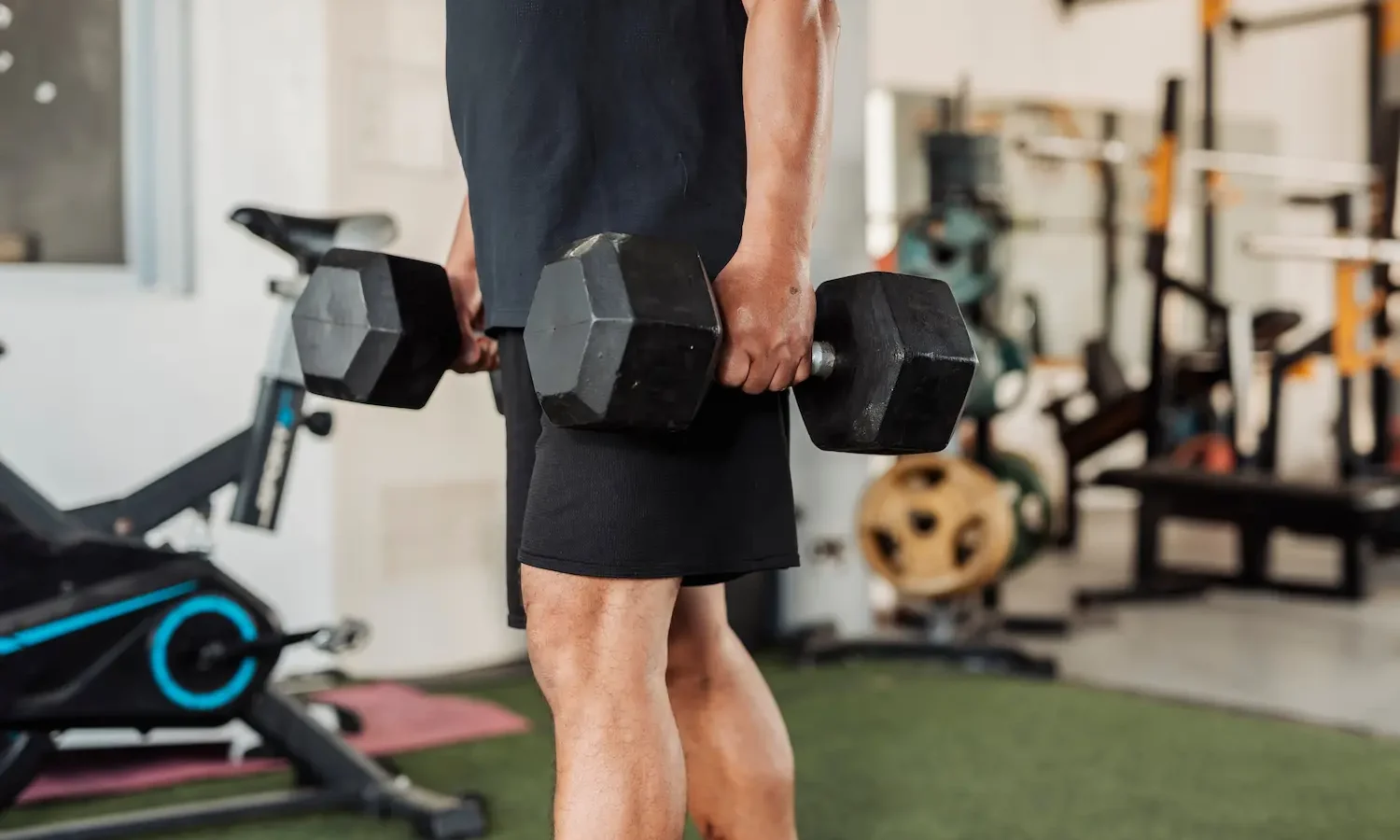
The suitcase carry is the unilateral version of the farmer walk — one heavy weight in one hand, the other hand empty. The asymmetric load forces the obliques on the opposite side to fire continuously to prevent the body from tipping sideways. It’s the single best anti-lateral-flexion core exercise in any program.
For lifters whose core training is mostly crunches and planks (anti-extension only), adding suitcase carries trains the missing dimension: anti-lateral-flexion under load. It carries over to sports, lifting, and life.
What is the suitcase carry?
The suitcase carry is a unilateral loaded carry. You grip a single heavy weight (dumbbell, kettlebell, or trap-bar half-loaded) in one hand at your side, stand up tall, and walk a prescribed distance or time while keeping the body perfectly upright. The empty hand stays at the side or in front. After the prescribed work, switch hands and repeat.
The genius of the exercise is the asymmetric loading. With weight in only one hand, gravity wants to pull that side of the body down — and the obliques on the opposite side have to fire continuously to prevent it. The result: brutal core stabilisation training without crunches.
Muscles worked
| Muscle group | Role | Contribution |
|---|---|---|
| Obliques (off-side) | Primary mover, anti-lateral-flexion | ~35 % |
| Quadratus lumborum (off-side) | Anti-lateral-flexion deep | ~20 % |
| Forearms, grip | Holding the load | ~15 % |
| Traps, lats, upper back (working side) | Scapular stability, anti-shrug | ~15 % |
| Glutes, hip stabilisers, legs | Walking propulsion + lateral stability | ~15 % |
The suitcase carry trains the deep obliques and QL — muscles that bilateral exercises hide. For anyone who has ever felt asymmetric back tightness, this carry usually exposes (and fixes) the imbalance.
How to suitcase carry: 5 steps
-
Set up with the weight on one side
Place a heavy dumbbell or kettlebell on the floor at one side. Stand beside it, feet shoulder-width. Free hand at the side (or in front for balance).
-
Pick up the weight with one hand
**Hinge at the hips with neutral spine, brace core hard**, grip the weight with one hand. **Stand up to fully upright posture**, weight hanging at the working-side hip.
-
Set the perfectly upright body line
**Body must stay vertical** — no tilt toward the loaded side. Shoulders level. Hips level. Brace the off-side obliques and QL hard. Free hand at the side, neutral.
-
Walk forward staying upright
**Walk forward with normal stride length**, maintaining the perfectly upright body line every step. Resist the gravity pull of the asymmetric load. Breath steady, core constantly engaged.
-
Set down and switch sides
After the target distance, **hinge at hips and set the weight down with control**. Walk back, rest as prescribed, then **repeat with the weight in the other hand**. Always do equal reps per side.
Common mistakes to avoid
Variations
- Single-arm overhead carry. Weight held overhead with one arm. Brutal shoulder stability + core demand.
- Single-arm front-rack carry. Kettlebell in front-rack position on one side. Anti-lateral-flexion + front-rack endurance.
- Waiter walk. Weight overhead, one arm — like serving a tray. Extreme shoulder stability work.
- Asymmetric loaded carry. Heavy weight in one hand, lighter weight in the other. Bridges suitcase and farmer.
- Farmer walk. Bilateral counterpart.
- Side plank. Static anti-lateral-flexion equivalent.
Sample workouts
Strength block
4 sets per side × 20 m heavy suitcase carry. Load: 40-60 % of your farmer-walk total per hand. Rest 60-90 seconds between sides; 2 minutes between sets.
Core block
3 sets per side × 40 m moderate suitcase carry — slow pace. Focus on staying perfectly upright every step.
Conditioning superset
EMOM 10 minutes: 20 m suitcase carry (alternate sides each minute). Rest the remaining time.
Frequently asked questions
How heavy should the suitcase carry be?
Heavier than people think for core work. Start at 30 % of your farmer-walk total per hand (so if you can farmer walk 2 × 25 kg easily, try a 30 kg suitcase). Build to 40-50 % of bodyweight per hand for serious core stimulus.
Suitcase carry or side plank?
Different. Side planks are static anti-lateral-flexion. Suitcase carries are dynamic anti-lateral-flexion under heavy load. Both work; carries usually transfer more directly to athletic and lifting carryover.
Why is my off-side (empty-hand side) so sore the next day?
That’s the deep obliques and QL doing their job. The asymmetric load forces those muscles to work the entire walk — much longer time under tension than they’re used to. Soreness fades within 2-3 sessions as they adapt.
How often should I do suitcase carries?
2-3 times per week is plenty. Like the farmer walk, they’re demanding on grip and traps. Use them as accessory work on pull days or as a core finisher.
Will suitcase carries fix my back imbalance?
Often yes. Many back imbalances stem from asymmetric oblique weakness. Suitcase carries (always equal reps per side) trained over 6-8 weeks frequently reduce asymmetric back tightness. Not a cure-all — but a frequent contributor.
Related exercises
- Farmer Walk: bilateral counterpart
- Side Plank: static anti-lateral-flexion
- Cable Wood Chop: rotational core power
- Dumbbell Row: unilateral pulling
- Plank: anti-extension core
Published by: Jay — Writer covering ab exercises
Reviewed, corrected and approved by: Martin Wood — Editor-in-chief
Updated on September 29, 2026