
The slam ball is the rawest, most cathartic conditioning exercise in the gym. You lift a weighted slam ball overhead, then drive it down into the floor with maximum power. Pick it up, repeat. There’s no eccentric load on the body — only the explosive concentric throw down — making it joint-friendly while delivering serious cardio and power work.
Used as a finisher, a power developer, or a short brutal conditioning circuit, the slam ball deserves a place in any program looking for full-body output without joint cost.
What is the slam ball?
The slam ball is a conditioning exercise performed with a weighted “slam ball” (a non-bouncing dead-weight ball, typically 5-25 kg). You lift the ball from the floor to overhead, then drive it down into the floor with maximum power, using full-body extension. The ball doesn’t bounce — you pick it up and repeat.
Because there’s no eccentric phase (the ball does the eccentric for you when it lands), the joints take far less stress than equivalent loading on barbells or kettlebells. Perfect for high-rep conditioning, post-rehab work, or anyone wanting power output without compounding load on the spine.
Muscles worked
| Muscle group | Role | Contribution |
|---|---|---|
| Rectus abdominis, obliques | Spinal flexion power | ~30 % |
| Lats, triceps | Overhead drive down | ~25 % |
| Glutes, hamstrings | Hip extension to load the ball | ~20 % |
| Shoulders, traps | Bar setup, scapular control | ~15 % |
| Quads, calves | Squat-pick-up phase | ~10 % |
The slam ball is one of the few conditioning exercises that genuinely loads the abs as a power-producing muscle (not just a stabiliser). The slam-down drive comes from explosive spinal flexion — a pattern you can’t train safely with barbells.
How to slam ball: 5 steps
-
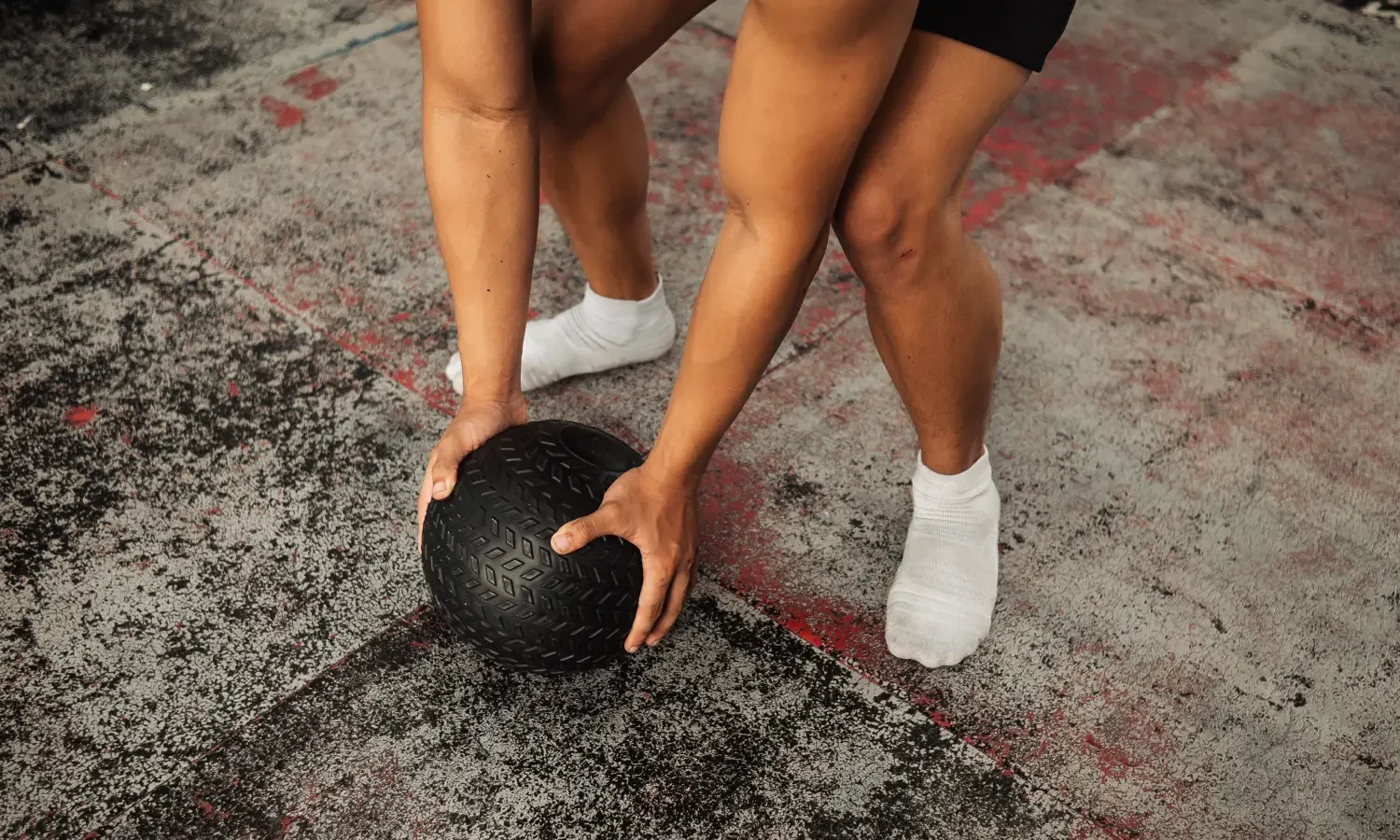
Set up with the ball at your feet
Stand with feet shoulder-width, slam ball on the floor between your feet. **Brace the core.** Maintain a clear space around you — slamming creates rebound and noise.
-
Lift the ball overhead
**Squat to grip the ball** with both hands. **Stand up explosively** while raising the ball straight overhead. Reach full extension at the top — arms straight, ball directly above the head.
-
Crunch and drive the ball down
**Crunch forward at the hips and spine** while **driving the ball down powerfully** with the arms and lats. The slam comes from explosive spinal flexion + arm pull-down combined.
-
Release the ball on impact
**Release the ball at the moment of impact** with the floor — no follow-through that pulls you forward unsafely. Body finishes in a slight forward-hinged position over the slammed ball.
-
Pick up and repeat
Squat down, pick up the ball, return to standing. Reset, repeat. Maintain explosive intent on every slam — don't let the rhythm get lazy.
Common mistakes to avoid
Variations
- Rotational slam ball. Slam to the left or right of the body. Adds rotational power.
- Single-arm slam ball. One arm at a time. Major anti-rotation core demand.
- Squat slam. Full squat before each slam — leg-power version.
- Slam ball burpee. Burpee + slam combination. Pure conditioning hell.
- Medicine ball slam. Standard med-ball with slight bounce. Different feel.
- Wall ball. Upward throw counterpart.
Sample workouts
Power EMOM
EMOM 10 minutes: 8 slams. Rest the remaining time. Reset focus on max power per rep.
Tabata finisher
8 rounds of: 20 seconds slam balls / 10 seconds rest. Total: 4 minutes. Brutal core-and-cardio finisher.
Conditioning circuit
5 rounds for time: 15 slam balls + 10 burpees + 20 mountain climbers. Race the clock.
Frequently asked questions
What weight slam ball should I use?
Heavier than you think for power work. Beginners: 5-8 kg. Intermediate: 10-15 kg. Advanced: 15-25 kg. The ball should let you maintain explosive intent on every rep. If you slow down, the load is too heavy.
Slam ball or medicine ball?
Slam balls don’t bounce — designed to be slammed repeatedly. Medicine balls have some bounce — meant for throws and partner work. For slamming, use a slam ball (or a “dead ball” / “wall ball” that doesn’t bounce significantly).
Is the slam ball safe for the back?
Yes — there’s no eccentric load. The ball does the eccentric work when it lands. The only spine stress is the slam itself (powerful concentric flexion), which the spine handles well at moderate loads. People with active disc issues should still consult a professional first.
Slam ball as a daily exercise?
2-3 sessions per week is plenty for most. Daily heavy slams will fatigue the lower back and core. Light daily slams (10-15 reps with a 5 kg ball) work as a warm-up activation.
Why do I feel it more in my shoulders than my abs?
You’re using the arms to drive the ball down. The arms should be a fixed lever; the core does the slam by flexing the spine forward. Cue “punch the floor with your belly button, not your hands”.
Related exercises
- Wall Ball: upward throw counterpart
- Burpee: full-body conditioning
- Kettlebell Swing: hip-power compound
- Box Jump: explosive leg power
- Cable Wood Chop: rotational power core
Published by: Jay — Writer covering ab exercises
Reviewed, corrected and approved by: Martin Wood — Editor-in-chief
Updated on September 29, 2026