
The dumbbell curl is the most popular exercise in any commercial gym, and probably the most badly performed. It looks simple — pick up a dumbbell, lift it toward your shoulder, lower it. Three motions, one muscle group. What could go wrong?
A lot, as it turns out. Most people swing the weight, cut the range of motion, ignore the eccentric, and then wonder why their arms aren’t growing. The dumbbell curl is one of those exercises where switching from sloppy to strict is more impactful than adding 5 kg. This guide covers the strict version, the way to actually grow biceps with curls, and the variations worth running once you’ve earned them.
What is the dumbbell curl?
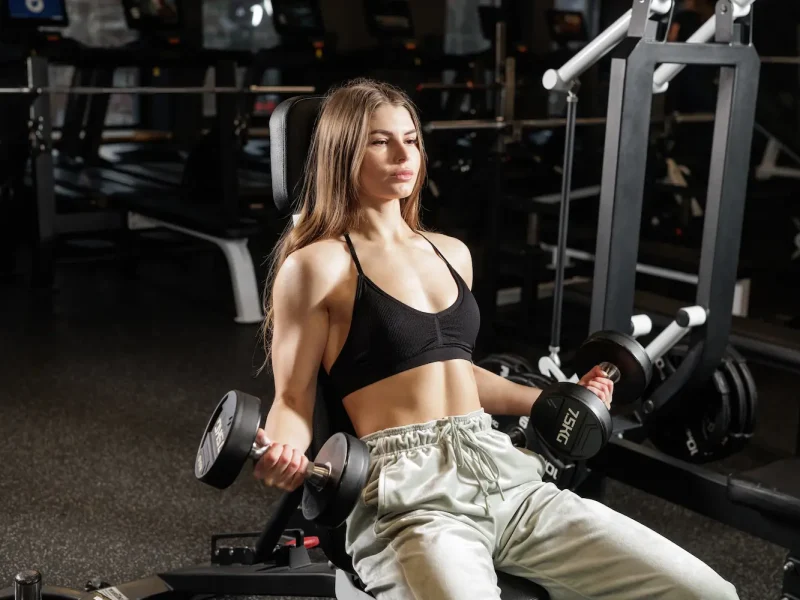
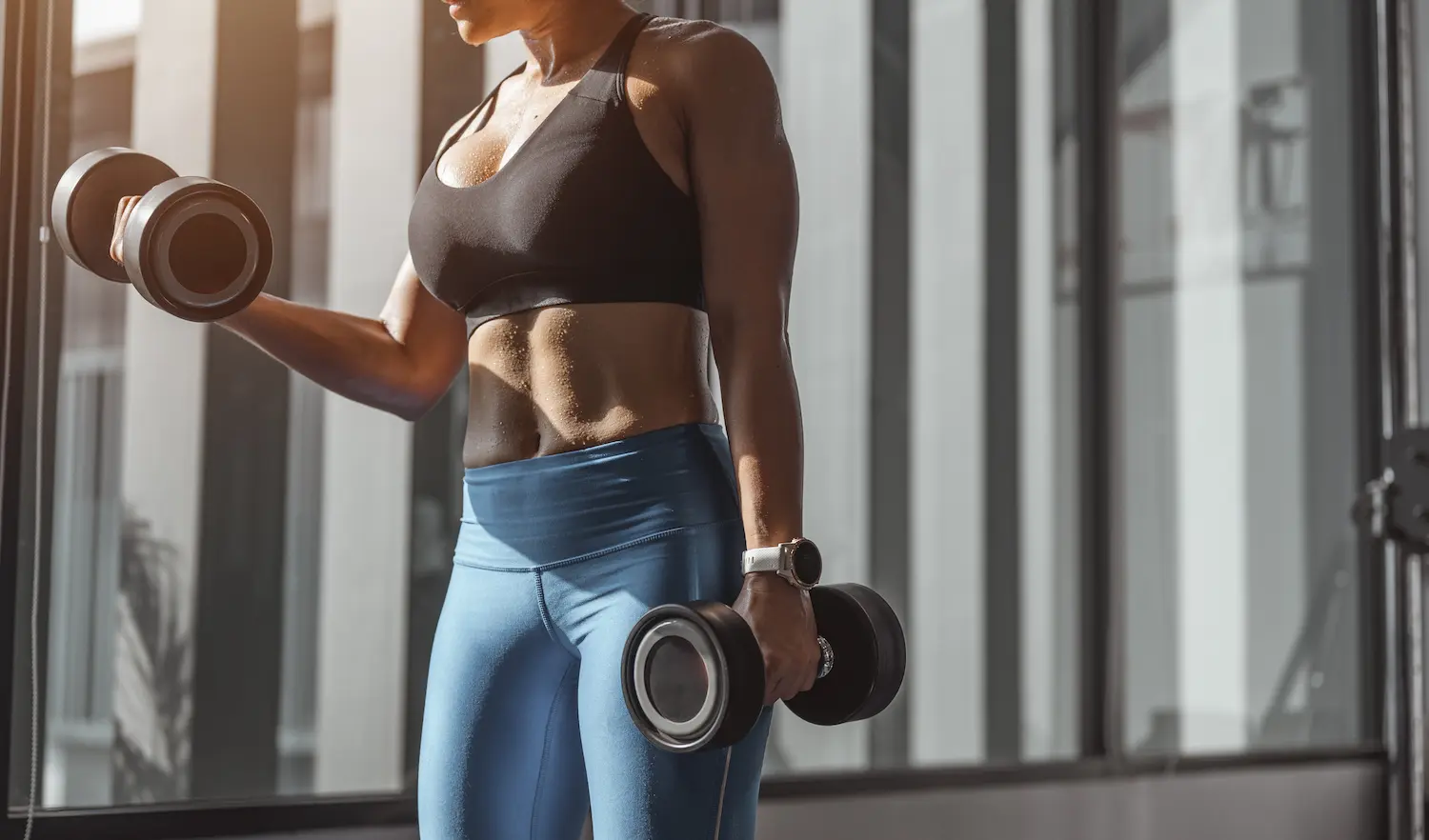
The dumbbell curl is an isolation exercise for the biceps in which you stand or sit holding a dumbbell in each hand at arm’s length, then bend the elbow to bring the dumbbell toward the shoulder. The standard version uses a supinated grip (palms facing up throughout) and either alternates arms or works both at once.
It’s an isolation exercise, meaning it works one joint (the elbow) and one muscle group (the biceps + supporting forearm muscles). Compared to a pull-up or a barbell row, the curl produces less total work but more targeted biceps stimulus. Both have value: compounds for total back/biceps work, curls for finishing the biceps after the heavy lifting.
The dumbbell curl has one major advantage over the barbell curl — each arm works independently, so left-right strength differences can’t hide behind one another. If your weaker side can do 8 reps with 12 kg, the stronger side trains 12 kg, not 14 — you build symmetric arms.
Muscles worked
The curl loads three flexor muscles in the upper arm and forearm:
| Muscle group | Role | Contribution |
|---|---|---|
| Biceps brachii (long head + short head) | Primary mover, elbow flexion | ~70 % |
| Brachialis | Elbow flexion (under the biceps) | ~20 % |
| Brachioradialis | Forearm flexion | ~10 % |
The biceps is what people picture when they say “biceps”, but the brachialis sitting underneath does a huge amount of the work and visually pushes the biceps up — making the upper arm look bigger when developed. Hammer curls (palms facing each other) bias the brachialis more than standard curls, which is why most well-developed arms include both.
How to dumbbell curl: 5 steps
Read all five steps. The strict version is rarer than you’d expect at any gym.
-
Set the start position
Stand feet shoulder-width, knees soft. Dumbbell in each hand, arms fully extended at sides, **palms facing forward**. Shoulders pulled back.
-
Brace and lock elbows
Squeeze abs gently. **Elbows pinned to your sides** throughout — they do not drift forward or backward.
-
Curl up with intent
Bend elbows to bring dumbbells toward your shoulders. **Squeeze the biceps hard at the top.** Stop when dumbbells reach front shoulder height — no further.
-
Pause at the top
Half-second pause, biceps fully contracted. No bouncing.
-
Lower in 2-3 seconds
The eccentric is where growth happens. Lower slowly. Fully extend the arm at the bottom — don't stop short.
A clean curl rep takes 4-5 seconds. If yours are happening in 1-2 seconds, you’re swinging.
Common mistakes to avoid
The dumbbell curl is mechanically easy and mentally hard. Five mistakes account for 90 % of “I don’t grow biceps” complaints.
Dumbbell curl variations
- Hammer curl. Palms facing each other (neutral grip). Biases the brachialis and brachioradialis. Excellent for forearm and overall arm thickness.
- Concentration curl. Seated, elbow braced against the inner thigh. Forces complete strict form, pure biceps work.
- Incline curl. Lying back on a bench at 45°. Stretches the biceps further at the bottom. Excellent for the long head of the biceps.
- Preacher curl. Arms over a sloped pad. Eliminates body English entirely. Demanding on the elbow tendons.
- Spider curl. Lying chest-down on an incline bench, arms hanging straight. Peak biceps contraction at the top.
- Cable curl. Constant tension throughout the range. Better mind-muscle work for some lifters.
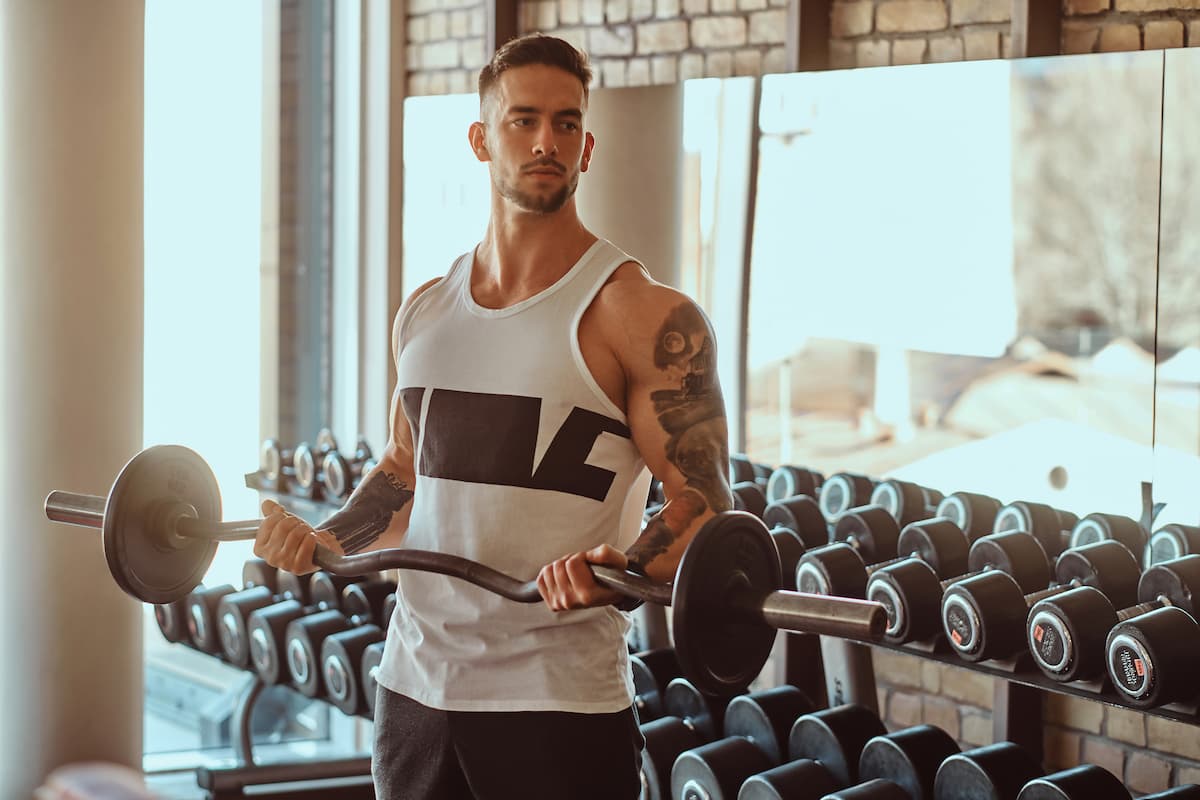
- Barbell curl. Both hands on a bar. Allows heavier loads, less individual asymmetry work.
Sample workout: 4-week biceps block
Curls 2 times per week, after your main back work (so the biceps are slightly pre-fatigued).
| Week | Sets × reps | Tempo | RPE |
|---|---|---|---|
| 1 | 3 × 12 | Slow eccentric (3 sec) | 7 |
| 2 | 4 × 10 | Slow eccentric | 7-8 |
| 3 | 4 × 8 | Slow eccentric + 1 sec pause at top | 8 |
| 4 (deload) | 3 × 8 | Smooth | 6 |
Frequently asked questions
How heavy should I curl?
A reasonable bench for a healthy male intermediate lifter: 14-18 kg per dumbbell for 8 strict reps. For females: 6-10 kg. The right weight is what you can curl strict for the prescribed reps — full range, no swinging, controlled eccentric.
Why aren’t my biceps growing despite curling 4 times a week?
Three usual causes. Too heavy/sloppy form. Not enough back work — heavy pull-ups, rows and pulldowns build the biceps massively. Or nutrition — biceps grow on calorie surplus and protein.
Should I curl every day?
No. Biceps recover in 48-72 hours after a hard session. More than 2-3 dedicated biceps sessions per week is overtraining.
Are dumbbell curls or barbell curls better?
Dumbbell for symmetry and ROM. Barbell for heavier loading. Most balanced programs include both.
What’s the difference between a dumbbell curl and a hammer curl?
Grip orientation. Standard curl uses a supinated grip (palms up); hammer curl uses a neutral grip (palms facing each other). Hammer biases the brachialis; standard biases the biceps brachii.
Related exercises
- Hammer Curl: brachialis emphasis, neutral grip
- Barbell Curl: heavier loading, both arms
- Concentration Curl: strict isolation, single arm
- Preacher Curl: bottom-range biceps work
- Cable Curl: constant tension throughout
Published by: Jay — Writer covering biceps exercises
Reviewed, corrected and approved by: Martin Wood — Editor-in-chief
Updated on September 29, 2026