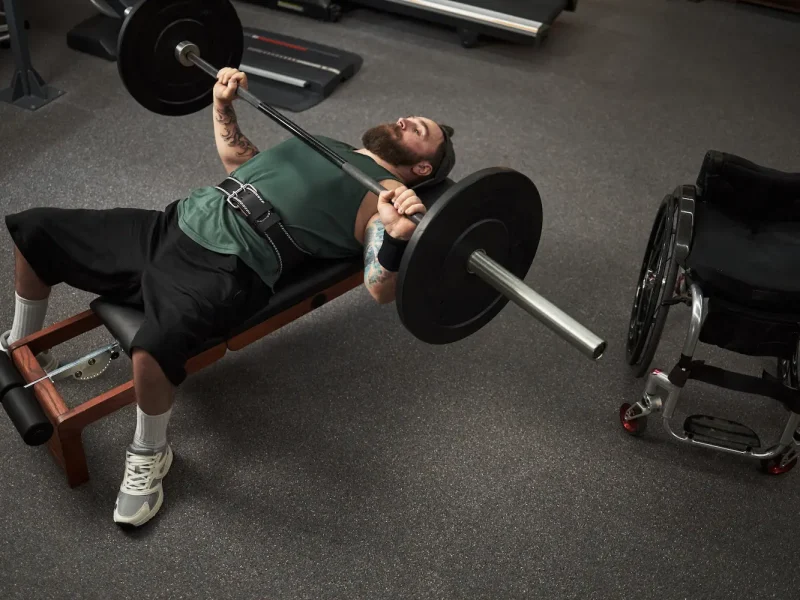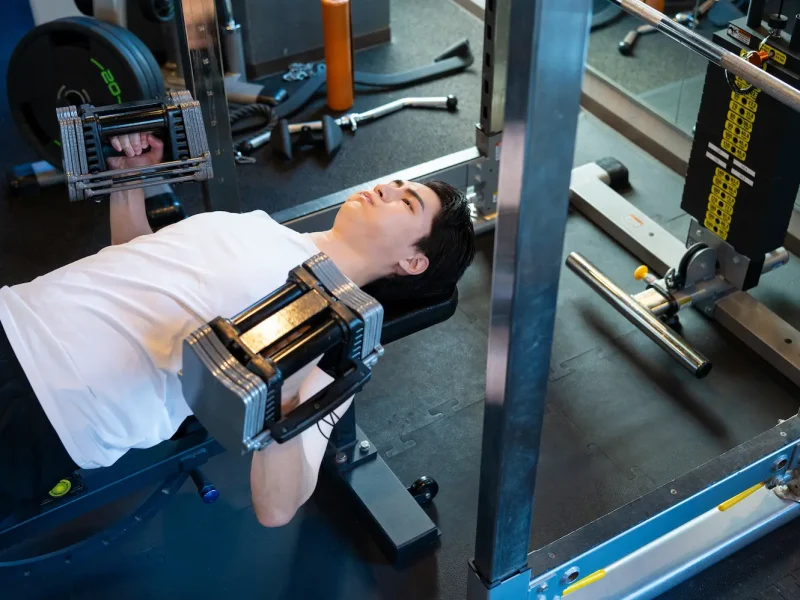

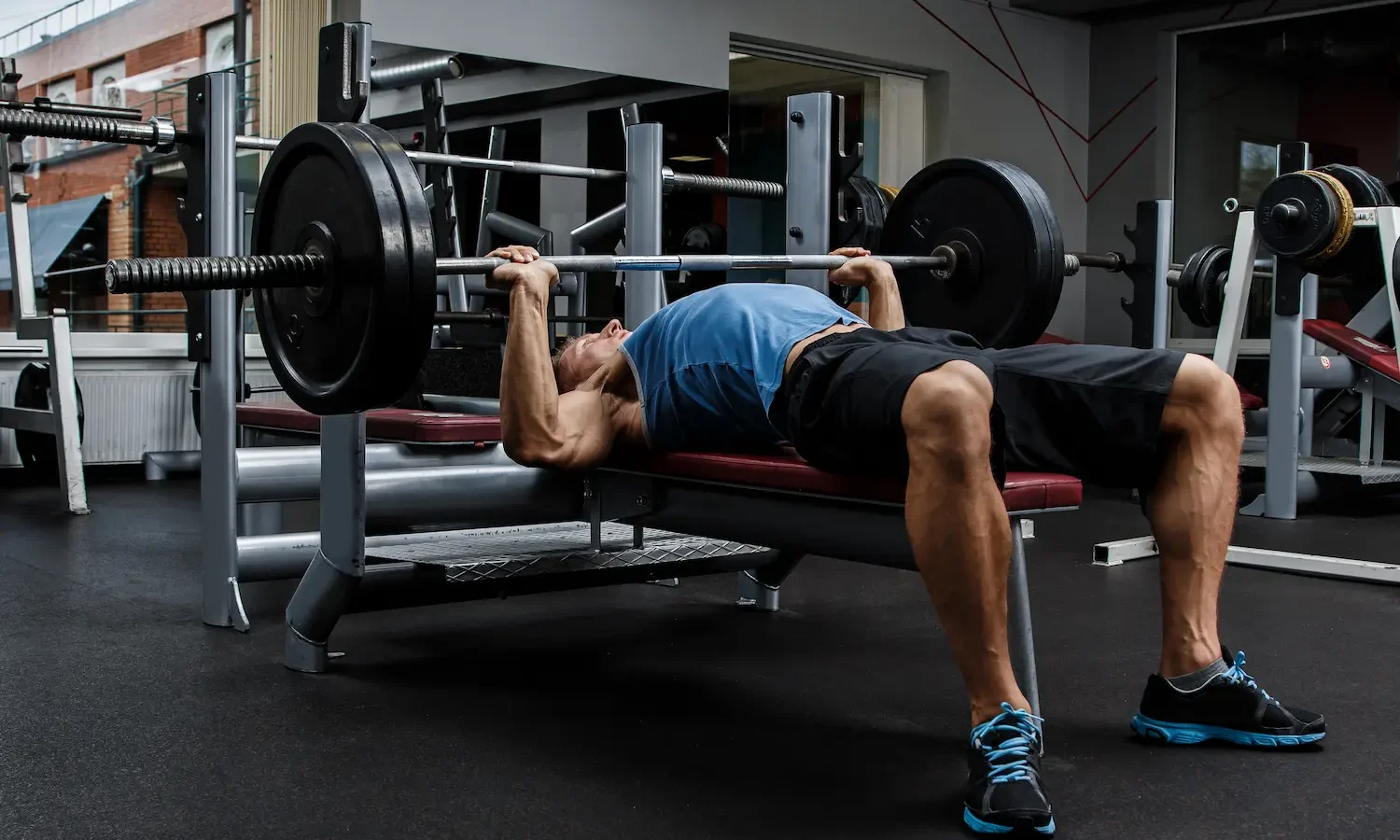
The bench press is the gold-standard upper-body strength test in any gym you walk into, anywhere in the world. It’s also the lift most people get wrong, usually because they learned it from someone who learned it wrong twenty years ago. Done with attention, the bench press builds a thick chest and strong triceps without wrecking your shoulders. Done with ego, it stalls progress and quietly grinds the front of your shoulder into a flag of pain.
This guide is for the second case, mostly. We’ll cover what the bench press actually trains, how to set it up step by step, the five mistakes that cost beginners months of progress, and the variations worth rotating through once you’ve earned the right to graduate from the flat bar.
What is the bench press?
The bench press is a horizontal pushing movement performed lying flat on a bench, lowering a loaded barbell to mid-chest and pressing it back up to a locked-out position. It is one of the three lifts in powerlifting (alongside the squat and the deadlift) and a staple of nearly every general strength program written in the last eighty years.
Why is it so popular? A few reasons. It loads the chest, triceps and shoulders in a single coordinated movement, so a few good sets cover a lot of ground compared to picking apart each muscle with isolation work. It’s easy to track week to week — a bar is a bar, the path is short, the equipment is standardised. And it transfers. A stronger bench means stronger pushes, throws and presses out in the world.
It is not, as your gym buddy will insist on Monday, the only chest exercise that matters. But it earns its place at the top of the rotation.
Muscles worked
The bench press is a compound lift, meaning it recruits multiple joints and muscle groups working in concert. Here’s the rough work split:
| Muscle group | Role | Contribution |
|---|---|---|
| Pectoralis major (sternal head) | Primary mover, shoulder horizontal adduction | ~60 % |
| Triceps brachii | Elbow extension, lockout | ~25 % |
| Anterior deltoid | Press initiation, shoulder flexion | ~15 % |
| Serratus anterior · Rotator cuff · Lats | Stabilisation | (mandatory but not measured) |
The key word in that table is stabilisation. Most people picture the bench press as a chest exercise, but it’s really a full-body pressing pattern. The lats hold the back arch. The serratus anterior keeps the shoulder blades stacked against the ribcage. The rotator cuff keeps the humerus from sliding around inside the joint at heavy loads.
If your bench plateau won’t budge, the answer almost never lies in “more chest”. It lies in tighter back work, healthier rotator cuffs, and learning to actually press with the whole body instead of just shoving the bar with the arms.
How to bench press: 5 steps
Read each step in order before your first set. Cues marked in bold are non-negotiable; skipping them is how shoulders end up at the physio.
-
Set up under the bar
Lie flat on the bench, eyes directly below the bar. Plant feet firmly on the floor.
-
Grip the bar
Slightly wider than shoulder width. **Wrists stacked over forearms** — never bent backwards. Wrap the thumb fully around the bar.
-
Brace and unrack
Pinch shoulder blades together and pull them down. Take a deep breath, brace the core, and unrack to lockout.
-
Lower with control
Lower the bar to mid-chest in a controlled 2-3 second descent. Elbows tucked at **45-60° from the torso**.
-
Press up
Drive the bar up and slightly back toward the rack pillars in one explosive motion. Lock out elbows fully at the top.
A clean rep takes about four seconds. If yours is happening in less than two, you’re bouncing.
Common mistakes to avoid
The bench press is forgiving for the first 50 kg. After that it punishes shortcuts.
Bench press variations
Each variation shifts the work between chest, triceps and shoulders, or changes the demand on the joints. Cycle through them across a training block. Don’t pick one and grind for a year.
- Incline bench press. Bench at 30–45°. Hits the upper chest and front delts harder than the flat. The variation most carryover to the standing press.
- Decline bench press. Bench tilted down 15–30°. More lower chest, less shoulder. Easy on the cuff, often heavier than the flat.
- Close-grip bench press. Hands shoulder-width or slightly inside. Triceps focus. Excellent accessory for big benchers stuck on lockout.
- Dumbbell bench press. Greater range of motion than the bar. Forces left and right sides to work independently, which exposes asymmetries quickly.
- Floor press. Lying on the floor, no leg drive, ROM limited at the bottom. Bottom-half lockout work, easier on the shoulders.
- Paused bench press. Two-second pause on the chest. Kills the stretch reflex and exposes weak starts. The single most useful variation for lifters who can’t press what they can lower.
Sample workout: 4-week strength block
A foundation block for a beginner adding the bench press to a structured program. Bench twice per week. Add 2.5 kg to the working sets each week if all reps were clean.
| Week | Sets × reps | Intensity | RPE |
|---|---|---|---|
| 1 | 3 × 8 | 65 % of 1RM | 6–7 |
| 2 | 4 × 6 | 72 % | 7 |
| 3 | 5 × 5 | 78 % | 8 |
| 4 (deload) | 3 × 5 | 65 % | 6 |
After four weeks, retest the 1-rep max or rerun the block at the new working weights. Add one accessory chest exercise (incline dumbbell press for upper chest, push-ups to failure as a finisher) after the main work.
Frequently asked questions
How much should a beginner bench press?
A reasonable target after 6–12 months of consistent training is body weight for one rep. After that it varies enormously, depending on build, age, training history, and whether you have long arms (which makes the bench harder) or short arms (which makes it easier). Don’t compare yourself to the strongest person in the gym; compare yourself to last month’s you.
Is the bench press bad for my shoulders?
Only if you flare the elbows, ego-load the bar, or skip warm-ups. Done with elbows tucked at 45–60° and a steady tempo, the bench press is a safe and productive lift for the vast majority of healthy adults. If you have a pre-existing shoulder injury, see a physio before benching, and consider the floor press as a starting point: the limited ROM keeps the front of the shoulder out of the danger zone.
Do I need a spotter?
For heavy sets, yes, always. Or train inside a power rack with the safety pins set just above your chest at the bottom position. Failed reps without protection are how the bench press becomes the most dangerous lift in the gym. The pins cost nothing to set up and can save your sternum.
How often should I bench press?
Twice per week is the sweet spot for most beginners and intermediates. Once is enough to maintain strength, three times is enough to overcook the shoulders. Space the sessions at least 48 hours apart and pair the heavier session with lighter accessory work.
Should I bench press if I just want to look better, not lift big numbers?
Yes. The bench press, done in the 6–12 rep range, is one of the most efficient ways to build a thick, capable chest. You don’t have to powerlift. Pick a working weight, train it consistently for a year, and the visual results will follow.
Related exercises
If the bench press is the centrepiece of your chest routine, these are the supporting cast worth knowing.
- Incline Bench Press: upper chest specialist
- Dumbbell Bench Press: better ROM, exposes asymmetries
- Close-Grip Bench Press: lockout strength and triceps
- Floor Press: shoulder-friendly alternative
- Push-Up: bodyweight pattern, useful even at advanced levels
Published by: Jay — Writer covering chest exercises
Reviewed, corrected and approved by: Martin Wood — Editor-in-chief
Updated on May 7, 2026